Main Site

This is Gem Newman's blog. Return to the main site.

Quotation

Showing posts with label church. Show all posts

12 June 2017

LUEE Episode 121: "Dreams from My Real Father"

On this episode of Life, the Universe & Everything Else, Ashlyn, Lauren, Gem, and Laura talk about yet another conspiracy film, and Gem closes out the episode with an Alex Jones–themed quiz.

Life, the Universe & Everything Else is a podcast that delves into issues of science, critical thinking, and secular humanism.

Links: No more religious exemptions: Montreal is taxing churches (CTV Montreal News ) | Montreal churches fear stricter taxation after visits from inspectors (Montreal Gazette) | Dreams from My Real Father (Wikipedia) | Barack Obama (Wikipedia) | Frank Marshall Davis (Wikipedia) | Alex Jones (radio host) (Wikipedia)

Contact Us: Facebook | Twitter | Email

Listen: Direct Link | iTunes | Google Play | Stitcher | RSS Feed

12 December 2016

LUEE Episode 115: Holiday Charity Special

On the Life, the Universe & Everything Else Holiday Special, Brendan Curran-Johnson joins Gem, Laura, Ashlyn, and Lauren to talk about charitable giving, including how an organization qualifies as a charity, how to maximize the good your contributions can do, and some of the questionable practices of the most popular charities. The episode concludes with a rebroadcast of a segment from 2013's holiday episode contrasting the various nativity accounts.

Life, the Universe & Everything Else is a program promoting secular humanism and scientific skepticism that is produced by the Winnipeg Skeptics.

Definition of Charity: What is charitable? (Canada Revenue Agency)

Image vs. Effect: Dems help reopen a NC Repub office by David Weinberger (GoFundMe) | MEDIA ADVISORY: NCGOP Sees Encouraging Early Voting, Obama/Clinton Coalition Tired, Fail to Resonate in North Carolina | Courts are finally pointing out the racism behind voter ID laws (The Washington Post) | Today I did a lot of screaming about the anti-LGBT bill North Carolina passed (mcclure111) | Susan G. Komen Partners With Fracking Firm, Despite Possible Cancer Links (Huffington Post) | Pinkwashing (Wikipedia) | Chan Zuckerberg Initiative Promises to Spend $3 Billion to Research and Cure All Diseases (Forbes) | Mark Zuckerberg can't believe India is debating net neutrality rather than being grateful for Facebook's free internet (Quartz)

Effective Altruism: Effective altruism (Wikipedia) | GiveWell (Charity Reviews and Research) | Giving What We Can | 80,000 Hours | TRC #270: Effective Altruism + Drinking While Eating + Square on Toothpaste Tube (The Reality Check) | TRC #325: Cells On A Plane + Effective Donating Revisited + Sad Music (The Reality Check) | TRC #379: Charitable Giving + Premium vs Regular Gas + Elf On The Shelf (The Reality Check) | The Way to Produce a Person (The New York Times)

Donations in Kind: Understanding the Impact of Donated Clothes (WhyDev) | Why second-hand clothing donations are creating a dilemma for Kenya (The Guardian) | Stop donating canned goods to food drives: Your corned mutton castoffs are only making things worse (National Post) | Charities Need Your Money, Not Your Random Old Food (Slate) | The Problem With Little White Girls, Boys And Voluntourism (Huffington Post)

Winnipeg Harvest: Winnipeg Harvest | Winnipeg Harvest (Charity Intelligence)

Salvation Army: The Salvation Army in Canada Non-Discrimination | UK Salvation Army chief defends ban on gay members (PinkNews) | Here’s The Internal Document The Salvation Army Doesn't Want You To See (Queerty)

World Vision: FAQs (World Vision International) | World Vision Canada statement on sexual orientation and hiring practices | A World Vision Donor Sponsored a Boy. The Outcome Was a Mystery to Both. (The New York Times)

Other Charities That Need Your Help: Top Charities (GiveWell) | American Civil Liberties Union | Canadian Civil Liberties Association | Planned Parenthood | Action Canada for Sexual Health and Rights | Trans Lifeline (877-565-8860) | National Center for Transgender Equality | Trans Equality Rights in Canada | Advocating for LGBTQ Equality (Human Rights Campaign)

The "Charity Slump": The Holiday Giving Season: A Make or Break Time for Small Charities (CanadaHelps) | Charitable Giving in America: Some Facts and Figures | Why Charities Receive Less During The Summer (CanadaHelps)

Other Links: Episode 72: The War on Christmas: A Brief History (LUEE) | Episode 107: Solving Homelessness (LUEE) | Power In A Union on Vimeo | C.R.E.A.M. (Wu-Tang Clan) | The best God joke ever (Emo Phillips) | Are We the Baddies? (That Mitchell and Webb Look)

Contact Us: Facebook | Twitter | Email

Listen: Direct Link | iTunes | Google Play | Stitcher | RSS Feed

15 November 2015

Selling Religion Door to Door

One of the benefits of occasionally working from home is having the opportunity to engage in pleasant conversations with door-to-door missionaries. I know that for most people, seeing a pair of young men with matching ties and haircuts approaching their door will elicit a feeling somewhere between anger and resignation, but this particular intellectual pursuit is a hobby of mine, so for me it's an unexpected (and usually welcome) treat.

So when a couple of gentlemen from a local church stopped by a few weeks ago, I was delighted to take a break from improving Julia's stacktrace functionality to chat with them for a few minutes. And given that I'd just settled on "apologetics" as the topic for the next episode of Life, the Universe & Everything Else (it's a podcast miracle!), I figured that this might provide a valuable opportunity to hear what arguments feet-on-the-street missionaries were using these days.

So if you're interested in this topic, we discuss it in more detail on tomorrow's episode of Life, the Universe & Everything Else.

One of the things that I hear fairly often, from both the religious and the nonreligious alike, is that these sorts of metaphysical debates—the back and forth, argument and counterargument—are simply a waste of everyone's time. And I get that argument. If you don't want to spend time on it, if you don't feel that you get anything out of these conversations, by all means: don't. And if you're going into one of these conversations expecting to convince the other person that their god of choice doesn't exist, then you are wasting your time. You're definitely not going to do that immediately, and you're probably not going to convince them at all.

But as I said, I enjoy the point and counterpoint. But most importantly, it seems to me that being able to engage thoughtfully in highly charged discussions with people that we disagree with and actually attempting to understand other points of view... that's a very important life skill, and it's one that I try to cultivate. And if they want to come to my door, that's an invitation to a conversation, and it's one I'm (usually) happy to accept.

But my first rule is to be friendly. Because come on, friendliness is pleasant, and these people are also human beings.

A missionary. (Artist's impression.)

I have a hypothetical that I like to pose to missionaries who come to my door. Obviously they believe that God is an active presence in the world, tinkering here and there (you don't get many deist missionaries these days, unfortunately). But say that God suddenly stopped performing miracles and intervening in people's lives. What about the world would be different?

The way I see it, good things and bad things would still happen in the world. Athletes would still win sports games, people would still find their lost car keys, lotteries would still be won. People would still be good to each other now and again. Doctors would still save lives. Amputees who prayed would still not regrow their limbs.

I don't often get a very satisfactory answer.

The men who greeted me when I got up to get the door weren't Mormon: they were too mismatched. One was in his twenties, while another was older and bearded (I think), and neither was wearing a tie. It was the younger man who rang the doorbell, the older fellow content to watch from the walk.

"Many people are concerned about the state of the world," the younger man began, "what with refugees in Syria and all of the terrible things going on. I have a question for you, sir: Do you think that the world will get better?"

I thought about it for a moment, then I agreed that yeah, I was pretty confident that things were getting better, little by little, day by day. On most days (my brighter days), it seems to me that Reverend King was right about arc of the moral universe.

"That's great," he said, "that's very optimistic." Although to be honest he seemed a little put off by my answer. I think he was expecting more pessimism than he got. (They should have waited until November to stop by: NaNoWriMo was only a few days away.)

He moved on to the next point on his mental bullet-list: "Do you ever wonder what God's plan is for us, or why he allows suffering?"

No.

"No? Why not?"

Because I don’t believe in any gods. I don't spend a lot of time speculating on the plans of fictional characters. (That last part was a lie, now that I think about it. Which reminds me: I should be working on my novel instead of writing this.)

The younger fellow's eyebrows shot up, and he glanced back at the older man. The bearded fellow stepped in, thinking (or so I imagine): Aha! An atheist! Don't worry, son. I'll handle this!

"Then who created all of this?" he said, gesturing expansively.

I pointed out that the way he phrased the question was a little unfair, because to say "who created" presupposes a creator. It's a loaded question.

"Okay, fine. You're right. But where did this all come from, then?"

I shrugged. I don't know, and I don't pretend to. But I asked him to imagine that I gave him a present, a sweater for example. Perhaps, enamoured with his gift, he wants to know where I got it, but alas I've forgotten. Perhaps he might announce, then, that he's sure I got it from Mars. I protest that I'm pretty sure that "Mars" isn't the right answer, but he insists that unless I can tell him exactly where I got it, and provide documentary proof, then he's going to go with "Mars" as his answer for where the sweater came from and I should, too.

Not a perfect analogy, but I've certainly made worse. Speculating as to the provenance of a boulder lying at the foot of a mountain would have maybe been a better analogy. I try not to bore people with l'esprit de l'escalier, but mentioning it here is better than trying to track the pair down to attempt to recreate the same conversation so that I can get it right.

Anyway, my point is that this is a classic "God of the Gaps" argument. Functionally, it's an appeal to ignorance.

"Well," the older man says, gesturing, "we see a house, and we know that it has a builder." He leaves it there, but but the implication is that the universe should be seen the same way.

I refrained from pointing out that this particular house seemed to have a pretty slipshod builder, and it was in pretty poor repair. He'd probably have responded with something about "original sin" anyway, and I don't think that's covered by homeowner's insurance (what with it arguably being an Act of God).

But the real question is: How? (Or maybe "Why?") When we look at a house, how do we know that it has a builder? Well, we see other houses being built. We see draughtsmen designing them, and construction workers building them.

At this point he started talking about tornados in junkyards and I may have blacked out for a few minutes. The next thing I remember, he was talking about fine tuning.

"But our world is so perfect for us. What are the chances? The angle of the earth's axis is exactly 23½ degrees..."

He trailed off here, and I assume he was expecting some response beyond, "Yeah, seasons are nice," so I quoted some Douglas Adams for him.

I also pointed out that his argument ignored the rather interesting fact that the vast majority of the universe is not only empty, but also instantaneously lethal to pretty much any form of life that we can name.

And finally, asking "What are the chances?" that conditions would be right for our kind of life rather seems to assume that our kind of life was the point all along. But if conditions had been different, perhaps another kind of life might have emerged. It's like someone winning the lottery, and taking that to mean that the lottery had been designed with that person in mind, when in fact (as we all understand) someone else might have won, or perhaps nobody at all, and maybe sometime down the line there would be another set of numbers drawn.

It was at this point that the younger missionary started tugging at the older one. "Come on, let's go," he said.

I told them that I was sorry if I was boring them or wasting their time, but they did come to talk to me after all. But the older one was starting to get a little riled up by then.

"So let me ask you this," he began. "What do you believe is Man's ultimate purpose?"

To begin with I took a bit of an issue with him referring to all of humanity simply as "Man", and he sputtered indignantly a bit. But I tried to find some common ground, telling him that I believed that it's important for everyone to feel that they have purpose and direction in their life. But as far as an ultimate purpose? I simply don't see any reason to think that some "ultimate" purpose exists.

"Then what’s to stop me from stealing and just doing whatever I want."

Nothing, I suppose. Well, maybe a few things. Boy, is stealing really what he wants to do?

I mean, some people do just do whatever they want. But if you're stealing and hurting others, then people probably won't like you very much. People wouldn't want you around, you wouldn't have very many friends, and you'd likely wind up in jail. There are plenty of reasons you might not to want that.

But I told him that to quite a large degree I do do whatever I want. (And, as an aside, I recognize that this puts me in a position of staggering privilege.) But I wouldn't want to hurt someone else. If stealing and hurting others is what you really want, then that's a rather sad existence, isn't it?

I have empathy for others. I wouldn't want to cause hurt.

"Aha! But where does that empathy come from?" (Okay, he may not have actually said "aha", but he definitely had a triumphant look on his face.)

I told him that seems likely to me that some of our empathy is innate, but I'm sure that my upbringing had a lot to do with it. As a parent, I can say that empathy is to a large degree a learned behaviour, and I'm grateful to have had some very good teachers, because when I was younger it wasn't always easy to imagine that other people were just as important and worthy of consideration as me.

Ultimately, we are a social species (as much as that's hard for some of us, sometimes). It's important that we all have supportive communities. I told him that I was confident that his church provides its congregants with exactly that. And while I wished him well with it, I didn't think it likely that I'd be joining that particular community today.

The older fellow shook my hand, the younger fellow finally succeeded in pulling him away, and I went back to my work.

23 June 2014

LUEE Episode 83: Live from the Calgary Secular Church

In this episode of Life, the Universe & Everything Else, Greg Christensen visits the Calgary Secular Church and interviews CSC minister Korey Peters.

Life, the Universe & Everything Else is a program promoting secular humanism and scientific skepticism presented by the Winnipeg Skeptics and the Humanists, Atheists & Agnostics of Manitoba.

Links: Calgary Secular Church Website | Meetup Group

Contact Us: Facebook | Twitter | Email

Listen: Direct Link | iTunes | Stitcher | RSS Feed

15 December 2013

LUEE Episode 72: The War on Christmas: A Brief History

Episode 72: The War on Christmas: A Brief History

In this episode of Life, the Universe & Everything Else, Gem Newman discusses the nativity story and the way we celebrate Christmas with Richelle McCullough, Jeffrey Olsson, and Ian Leung, then hosts a rousing game of Santa Fact or Santa Fiction! Special thanks to Mat André, who helped Ian with our music this week.

Life, the Universe & Everything Else is a program promoting secular humanism and scientific skepticism presented by the Winnipeg Skeptics and the Humanists, Atheists & Agnostics of Manitoba.

Links: Humanists, Atheists & Agnostics of Manitoba | Calgary Secular Church | Chris Hadfield | Discrepancies in the Nativity Accounts (Matthew 1:18–2:23, Luke 1:26–2:40, Wikipedia, Errancy.org) | Herod the Great | Census of Quirinius | Celebrating Christmas in Canada: A Public Opinion Study | Don't Fall For the Salvation Army's PR Spin! They're Still Super Antigay | Focus on the Family's 2008 Christmas-Friendly Shopping Guide | The War on Christmas (Time Magazine, Wikipedia) | Jul (Yule) | Saturnalia | Sol Invictus

Santa Fact or Santa Fiction! Sources: The Claus That Refreshes | 12 Weird Christmas Traditions | Christmas Tree Production | Spiders and Their Webs Are Not Showed the Door on Ukrainian Christmas | Switzerland's 'World's Best Father Christmas' Competition | Black Peter | El Caganer

Contact Us: Facebook | Twitter | Email

Listen: Direct Link | iTunes | Stitcher | RSS Feed

20 October 2013

LUEE Episode 68: Atheist Myths

Episode 68: Atheist Myths

Is atheism a religion? In this episode of Life, the Universe & Everything Else, Donna Harris, Greg Christensen, Pat Morrow, and Jeffrey Olsson take on a few of the myths and misconceptions about atheists.

Life, the Universe & Everything Else is a program promoting secular humanism and scientific skepticism presented by the Winnipeg Skeptics and the Humanists, Atheists & Agnostics of Manitoba.

Links: Atheist vs. Agnostic | Atheism starts its megachurch: Is it a religion now? | Calgary Secular Church | Michael Enright: Could Atheists please stop complaining? | Elizabeth Renzetti: Heavens, we atheists have become a smug, dreary lot | Betty Bowers Explains Traditional Marriage to Everyone Else

Contact Us: Facebook | Twitter | Email

Listen: Direct Link | iTunes | RSS Feed

05 May 2013

LUEE Episode 56: The "Atheist Agenda"

Episode 56: The "Atheist Agenda"

In this episode of Life, the Universe & Everything Else, Donna Harris is joined by Richelle McCullough, Robert Shindler, Greg Christensen, and Jeffrey Olsson to discuss the so-called "Atheist Agenda" and how it relates to what atheists actually want.

Life, the Universe & Everything Else is a program promoting secular humanism and scientific skepticism presented by the Winnipeg Skeptics and the Humanists, Atheists & Agnostics of Manitoba.

Links: @SkepticAction on Twitter | HAAM Meeting on May 11th | Drinking Skeptically on May 14th | The Atheist Agenda on Conservapedia | What is the "atheist agenda"? | Atheist Door Knockers | Studying science doesn't make you an atheist... but studying literature does!

Contact Us: Facebook | Twitter | Email

Listen: Direct Link | iTunes | RSS Feed

09 December 2012

LUEE Episode 43: News Update

Episode 43: News Update

In this episode of Life, the Universe & Everything Else, Ashlyn Noble, Donna Harris, and Mark Forkheim discuss local and international news of interest to skeptics, including Palestine's admission to the United Nations, a study demonstrating the benefits of flax, the Pope's new Twitter account, and more.

Life, the Universe & Everything Else is a program promoting secular humanism and scientific skepticism presented by the Winnipeg Skeptics and the Humanists, Atheists & Agnostics of Manitoba.

Links: Apocalypse 2012: The End of the World Party (Facebook Event, Meetup Event) | Flaxtastic! | The Palestinian UN Bid: What Happened and What Changed | Everyone Can Benefit from Naturopathic Care (apparently) | Pope Gets More Than Half a Million Twitter Followers Without Sending a Single Tweet | Cambridge University to Open Centre Studying the Risks of Technology to Humans | What If? The Robot Apocalypse

Contact Us: Facebook | Twitter | Email

Listen: Direct Link | iTunes | RSS Feed

16 September 2012

LUEE Episode 31: News Update

Episode 31: News Update

In this episode of Life, the Universe & Everything Else, Ashlyn Noble is joined by Gem Newman, Greg Christensen, and Mark Whatman to discuss local and international news of interest to skeptics, including WiFi fears, the link between gay marriage and abortion, hominid fossils, and more! This episode is the first of our new biweekly news round-up shows. You can now expect a new episode every week!

Life, the Universe & Everything Else is a program promoting secular humanism and scientific skepticism presented by the Winnipeg Skeptics and the Humanists, Atheists & Agnostics of Manitoba.

Links: SkeptiCamp Winnipeg 2012 | Winnipeg Ghostbusters | Young Cannabis Smokers at Risk for Lower IQ | Winnipeg Church Being Turned into Low Income Housing | Baffling Campaign Ad Claims Same Sex Marriage Leads to More Abortions | The Winnipeg Free Press's "Letter of the Day": Schools Should Be Wired | WHO Fact Sheet on EHS | Episode 18: WiFi, Mobile Phones, and Electrosensitivity | New Fossils Put Face on Mysterious Human Ancestor

Contact Us: Facebook | Twitter | Email

Listen: Direct Link | iTunes | RSS Feed

12 October 2011

You're Paying for This Bigotry

So apparently many religious, publicly-funded schools in Manitoba are horrendous, bigoted institutions that attempt to indoctrinate children into a hateful, narrow-minded, anti-science philosophy. So, there's that.

Hat tip to Eric Legault.

04 October 2011

Skeptical News Roundup!

Some quick hits, cross-posted from the Winnipeg Skeptics blog!

Steve Thoms from Skeptic North has posted an excellent summary of the WiFi scare, detailing why you shouldn't worry too much about EMF.

This wonderful Pharyngula post was recently nominated for the 2011 edition of The Open Laboratory. This provides me with an excuse to link to it, which I've been meaning to do for months. Give it a read. Seriously, it's excellent.

Diana Goods of the Humanist Association of Manitoba wrote a nice letter to the editor explaining why Steinbach's newest megachurch isn't anything to get excited about. Hat tip to Jeff Olsson.

Also from Pharyngula comes the tale of this new lunacy from Orson Scott Card. Apparently Card's 2008 rewrite of Hamlet depicts the ghostly king as an evil paedophile who turns everyone gay. I'm not making this up.

And finally, on a lighter note, Felicia Day linked to this on Google+:


Also, these watches are awesomely geeky. That is all.

08 December 2010

Skeptical Investigations: The Creation Museum

Cross-posted from the Winnipeg Skeptics blog!

On 13 November 2010, Ashlyn Noble of the Winnipeg Skeptics organised a visit to Winnipeg's very own Creation Museum. An article detailing the trip appeared in the Uniter (discussed here), and prior to the trip several of us met to discuss the specific claims outlined on the museum's website (notes on specific claims can be found here). What follows is an account of the trip itself.

The museum is just around the corner from my house, so I walked. It was fairly chilly. I remember feeling relieved, as I'd just finished preparing for a talk that I was presenting later that evening, and I was looking forward to a bit of light fun. I was not to be disappointed.


When I arrived, several skeptics were loitering outside. We were a little early, and the University of Winnipeg's Atheist Student Association was touring the facility, so we stood around and gawked at the sign. It was vaguely reminiscent of Kent Hovind's—or, to give his full academic title: Mr. Kent Hovind's—dinosaur-themed plywood monstrosity of miseducation. This is probably because Kids Like Dinosaurs. Get 'em while they're young, right?

We were soon ushered inside and downstairs. In the basement we found a fair sized gymnasium, with a small side-room which contained the museum itself. Before being shown the exhibits by museum curator John Feakes, his assistant presented to us a slideshow which purported to highlight the main problems with atheism in general and evolution in specific (if you don't consider evolution to be a subdivision of atheism, well... then you're a rational person).

Before the slideshow began, I was personally presented with two items: a creationist textbook (In the Beginning: Compelling Evidence for Creation and the Flood, Eighth Edition, by Walt Brown, Ph.D., a mechanical engineer) and a compact disc, which contained the PowerPoint slides that we were about to see and a summary of the evidences found in the museum, along with citations where appropriate.

I'll make the museum notes and PowerPoint presentation available here; I think that the commentary that I'm providing constitutes fair use, and given my conversations with Mr. Feakes, I'm certain that he wouldn't mind. If it turns out that I'm mistaken, I will remove them. The entire text of In the Beginning is (apparently) available for free online here.

Museum Notes
PowerPoint Presentation

My overwhelming impression was that these people were genuinely open to discussion on the topic. I don't think that they were interested in having their minds changed, but, in stark contrast to Ray Comfort et al., I did not get the impression that they were being intellectually dishonest. Rather, I think that they were honestly mistaken—they had accepted several false (or unsupported) premises along the way, and now they were stuck.

I won't discuss the slideshow in detail, as it actually had very little to do with evolutionary theory, but it was very full of hilarity. A small sample:

Reason
Science
Morality
All unaccounted for by the atheist

FAIL.

The buoyancy of tugboats and the process by which moustaches grow are also unaccounted for by atheism. Atheism is a single position on a single topic. I'm not going to waste my time on these, because they are completely unrelated to the topic at hand. There are plenty of fairly good naturalistic explanations for the existence of these three concepts. If you want to learn about reason, science, and morality, I recommend you start by looking them up on Wikipedia.

Most of the claims that were made during the tour were actually dealt with in the post that I threw together before we went to the museum. I'd recommend checking it out. In the meantime, let's move on to the museum proper.


We started out with the blatant falsehood (sarcasm) that is the geologic column. Feakes repeated several of the claims from his website, we challenged them, etc., etc. ad nauseam. We were in a good position, as the eighteen (or so) of us were fairly well-versed in the theory of evolution. We were also lucky enough to have several specialists in the crowd, including students of both archaeology and biology and a biblical scholar. When the discussion moved past my (fairly broad but admittedly shallow) knowledge of the subject, these folks were all too happy to leap into the breach.


I noticed that the creationists evinced a bizarre (but not uncommon) tendency to conflate evolution, abiogenesis, and cosmogeny. I explained repeatedly that the theory of evolution only describes the origins of biodiversity after life first arose (although chemical evolution could probably carry us further back), while Feakes countered that he'd heard astronomers refer to stellar evolution. This seemed to be a sticky point for him, which it shouldn't be. I told him that whether evolution applies to stars depends on what is meant by "evolution": the word can be applied generally to refer to any sort of change over time or it can signify the biological theory which his museum purports to refute. To use both meanings at once is to be guilty of an fallacy of equivocation. The theory of evolution does not deal with the origins of life or of the cosmos. It's that simple.

I think that everyone maintained a fairly congenial demeanour throughout what quickly became a frustrating experience. Unfortunately, because we were pressed for time, we frequently had to curtail the debate and move on.


Over the course of the tour, Feakes made use of several arguments against evolution that even Answers in Genesis has repudiated. He acknowledged this fact with impressive forthrightness. His response? "When I start working for Answers in Genesis, I'll stop using these arguments." He seemed oblivious to the reason that AiG doesn't want him to use these arguments: they are absurd.

As the tour wore on, I grew increasingly annoyed by John Feakes' dogged insistence that these purported anomalies in the geological record falsified evolution. In exasperation, I pointed out that while evolution is at least in principle falsifiable, creationism is not.

"What do you mean?" he asked.

"Any set of evidences would be consistent with the work of an all-powerful creator deity. If you assume a God who can do anything, then anything that happens is consistent with your hypothesis!"

John disagreed, stating that he wasn't simply a creationist: he was a "Christian Creationist"—to falsify his position, one simply needed to falsify Jesus.

Oh, is that all? See, falsification is problematic when you're dealing with historical, rather than scientific, propositions.

Later, I pointed out that not only were there no contemporary, extrabiblical accounts of Jesus in history (and one could be forgiven for supposing that there should be, considering that he was magic), but that there was no reason to believe that the Gospels themselves were eyewitness accounts. Rather than being aghast at the suggestion that Matthew, Mark, Luke, and John might not have been written by Matthew, Mark, Luke, and John, I was amused to see that Feakes was more perplexed than anything. "What do you mean?" he asked. "John was one of the apostles and Mark was St. Peter's secretary." I found his innocence startling and a little sad. Yes, I know that's who John and Peter were supposed to be. But those attributions are almost entirely discredited by the textual critics who study the works in question.


During the section on human evolution, we spent some time discussing the complexity of DNA. Feakes spent a lot of time on arguments that just came down to the oft-refuted irreducible complexity. He also argued that the efficiency of information storage in DNA was evidence for design. I indicated that I found this puzzling, as DNA does not actually store information very efficiently at all. "What are you talking about?" Feakes asked. "DNA is basically double-coded binary. You're a computer guy, you know about binary!"

(Yes, he said "double-coded binary". I remember that exact term, because it was so weird. I guess he meant base-4, which would be more-or-less right.)

The thing is, as bases get smaller, efficiency drops. Binary is basically as inefficient as you can get in terms of information storage. Anyone who makes the smallest effort to understand the math knows that! Storing information in base-4 is the third-least efficient method that a creator deity might have used!

Mr. Feakes asked if I agreed that redundancy could be a sign of design. I easily granted him the premise that good design often had in-built redundancy: better to have two kidneys than just one, for example. John didn't really take this argument anywhere, though, and I found it amusing that he claimed both redundancy and efficiency as evidence of design.

Em examines reproductions of art that depicts either a stegosaurus or any other generic animal. You decide!

A creationist oncologist (now if that isn't a terrifying combination of adjectives, I don't know what is) showed up at one point, and asked me for a single example of observed evolution. Off the top of my head, I mentioned the (aerobic) metabolism of citrate in E. coli bacteria. This was, of course, unacceptable, because it was only "microevolution".

I find this defence hilarious, as they admit that "microevolution" occurs while discounting so-called macroevolution. I was happy to point out that young-Earthers actually believe in a much faster, more powerful version of evolution than "evilutionists": since they have roughly 4,500 years since the flood to explain biodiversity, originating from a (relative) handful of "kinds", they have to posit some sort of "super evolution", while simultaneously denying that small changes can add up to large ones.

See? Hilarious.

(That's not to say that rapid evolution has not been observed to occur: Robert points us to the example of the Italian Wall Lizard.)

This creationist oncologist fellow maintained that I still had no proof of evolution, and he responded with incredulity when I told him that "proof" isn't a scientific concept. I waited for his spluttering to die down before I said that proof is a philosophical, logical, and mathematical concept.

I went on to chat about the pseudogene that used to code for production of vitamin C. Because talkorigins.org has an excellent description of this research, prepare for some copy-pasta!

Recently, the L-gulano-γ-lactone oxidase gene, the gene required for Vitamin C synthesis, was found in humans and guinea pigs (Nishikimi et al. 1992; Nishikimi et al. 1994). It exists as a pseudogene, present but incapable of functioning (see prediction 4.4 for more about pseudogenes). In fact, since this was originally written the vitamin C pseudogene has been found in other primates, exactly as predicted by evolutionary theory. We now have the DNA sequences for this broken gene in chimpanzees, orangutans, and macaques (Ohta and Nishikimi 1999). And, as predicted, the malfunctioning human and chimpanzee pseudogenes are the most similar, followed by the human and orangutan genes, followed by the human and macaque genes, precisely as predicted by evolutionary theory. Furthermore, all of these genes have accumulated mutations at the exact rate predicted (the background rate of mutation for neutral DNA regions like pseudogenes) (Ohta and Nishikimi 1999).

An excellent example of a prediction made by evolutionary theory and later validated by scientists.

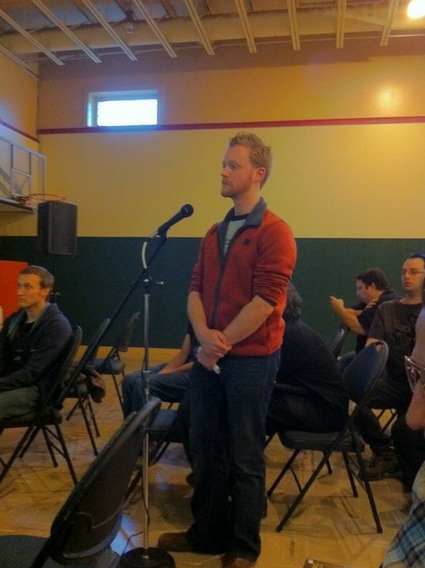
Ashlyn captioned this photo: "Gem – logicing the pants off the creationists."

After the main tour through the museum, we were treated to a Q&A session. It was apparently recorded by Feakes, however I don't have a copy. I'll try to summarise.

The Kalam cosmological argument was advanced. I pointed out the compositional fallacy involved in stating that since everything in the cosmos had a cause, therefore the cosmos itself had a cause. The end.

At one point, Feakes mentioned that God spoke to him. I was a little concerned by this, but the assembled creationists seemed surprised and offended when I asked if he actually heard God's voice audibly. Given what we'd seen and heard that afternoon, and that the man had just said that God spoke to him, I thought that it was a legitimate question.

Before we left, a church elder made the argument from prophecy. He said that the Jews had returned to reclaim Israel, which was somehow magical because they had been driven from their land, met with severe oppression and violence at every turn, with multiple attempts made to destroy their culture, all while remaining a distinct and identifiable people, before finally being given back their home.

The elder challenged us to name another group that had been systematically persecuted and nearly wiped out, but had survived as a distinct group with a unique culture. Without pause, I said, "Off the top of my head, American Aboriginals?" He blinked, then said: "But they haven't been systematically persecuted or wiped out!" At this point, the assembled skeptics erupted in derisive laughter.

But even if there weren't another group that fit his description, it's irrelevant. He's taking a description of what happened to the Jews and pretending that it was part of the prophecy, when (as far as I know), it wasn't (a kind of sharpshooter fallacy). It's not unlikely that there may have been Christian Zionists actively working toward this goal, making it a self-fulfilling prophecy. Or, it could be just one of those things that happens.

I'll quote from Iron Chariots:

The Bible (specifically Daniel) predicts that the nation of Israel would be reborn, and its creation in 1948 is often taken as the fulfillment of that prophecy. But of course this happened because people worked to make it happen, in part because of the prophecy. Most scholars believe the Israel that was "predicted" (Daniel was written after the fact) was the Israel created under the Maccabees.

Isn't it odd that every generation seems to claim that they are living in the final days before Armageddon?

For the most part, the museum boiled down to Christian Presuppositionalism, arguments from ignorance, irreducible complexity, and the idea that because some scientists had purportedly falsified data, the sciences of geology and archaeology could safely be dismissed. There was also, of course, a double-helping of anomaly hunting. (For more on anomaly hunting, I recommend these articles by Steve Novella.)

If you were there and you'd like to provide your take on the experience in comments, please do!

21 November 2010

Pope Says 'Your St. Peter Can Wear a Miter'. Catholics Rejoice.


Breaking news!

After decades of fierce opposition to the use of all contraception, the pontiff will end the Catholic Church's absolute ban on the use of condoms.

He will say that it is acceptable to use a prophylactic when the sole intention is to "reduce the risk of infection" from Aids.

...

Asked whether "the Catholic Church is not fundamentally against the use of condoms," he replies: "It of course does not see it as a real and moral solution.

This is a step in the right direction. Agreed. Perhaps, when the word gets out, this can finally stem the HIV epidemic in Africa.

But. This seems to simply be, yet again, an example of secular societal pressure dragging religion kicking and screaming away from their wholehearted embrace of dangerous dogma.

And the cynic in me can't help but think that perhaps the pontiff is throwing us a bone (as it were) to distract us from the other horrific things with which he's been involved. I'm happy about this decision—I'm ecstatic that lives will be saved!—but Ratzinger still doesn't get a pass on covering up child-rape.

Jeff Olsson, President of the Humanist Association of Manitoba, was just five minutes ago on Winnipeg radio station CJOB discussing this very issue. Two very misinformed callers just brought up the "fact" that HIV travels through the pores in latex condoms. Even after the Ratzinger flip-flops on condoms, the organised Catholic campaign of misinformation is still doing damage.

Tip o' the... you know... to Jen McCreight at Blag Hag and Jeffrey Olsson at HAM.

12 October 2010

The Pope Speaks on Technology

Gird your irony meters, folks.

According to Pope Ratzinger, technology makes it difficult to distinguish reality from fiction:

"New technologies and the progress they bring can make it impossible to distinguish truth from illusion and can lead to confusion between reality and virtual reality," the pope said.

"The image can also become independent from reality, it can give birth to a virtual word, with various consequences–above all the risk of indifference towards real life," he said.

"Impossible to distinguish truth from illusion"? "The risk of indifference towards real life"? Now what major world religion/corrupt gang of mobsters does that remind me of...?

Tip o' the miter to Brendan Curran-Johnson and Shunjie Lau.

17 September 2010

Skeptical News Roundup!

We have three items to talk about briefly.

The Pregnant Nun

First on the list is the pregnant nun ad that was recently banned in the UK:


"We considered the use of a nun pregnant through immaculate conception was likely to be seen as a distortion and mockery of the beliefs of Roman Catholics. We concluded that to use such an image in a light-hearted way to advertise ice cream was likely to cause serious offence to readers, particularly those who practised the Roman Catholic faith," the ASA decision says.

Obvious free-speech concerns aside, I'm annoyed that they're portraying a nun as "pregnant through immaculate conception". This is an annoyingly common distortion of Catholic dogma. The doctrine of immaculate conception has nothing whatever to do with the virgin birth: immaculate conception refers to Mary being purportedly conceived free from the stain of original sin.

Tip of the habit to my wife for sending me the link.

He's a Witch!

Next, we have the man who was arrested for practicing witchcraft:

A Brampton, Ont., man is charged with practising witchcraft to exorcise money from a victim.

...

"We really don't care if you want to practise witchcraft, as long as you don't allegedly defraud people," Peel police Sgt. Zahir Shah said.

He also urged people who have sought advice from the suspect to contact investigators.

"We know people may be embarrassed," Shah said, but police allege the suspect took advantage of the victims' beliefs to defraud them.

Okay, so (despite the headline) he wasn't actually arrested for practicing witchcraft—he was arrested for fraud. Perhaps some would call this a "stupid tax" (a name that I've often heard associated with the lottery), but not me. I'm simply not cool with taking advantage of people. Remember Wheaton's law: Don't be a dick.

Again, the missus gets a tip o' the spirit trumpet for alerting me to this one.

ZOMG!!1! The radia-shun is gonna get me!

And finally, Dr. Gifford-Jones has posted a follow-up to last week's article regarding so-called "dirty electricity", entitled Guard against dangers of radiation: Dirty electricity emitted from many devices we use:

Dirty electricity is produced when transformers convert clean 60-hertz household current into low-voltage power for electronic devices. This creates micro surges of electricity that contain up to 2,500 times the energy of a conventional 60-Hz system. This electrical pollution causes a negative effect on our health.

Honestly, there's not a lot of new information, here. At least he didn't talk to "renowned international expert" (and crackpot) Magda Havas again. (For more information, see my discussion of "dirty electricity" from earlier this week. Incidentally, it seems as though the Free Press has decided against publishing my letter to the editor.)

There are a couple of juicy tidbits here, though:

A Swedish study reported teens who use cellphones have five times greater chance of developing brain cancer than adult users.[citation needed]

"A Swedish study"? Could you be a little more specific?

If he's talking about INTERPHONE (mentioned later in his article, though not by name), I find it puzzling that, rather than referencing the entire study (which also included data from Australia, Canada, Denmark, Finland, France, Germany, Israel, Italy, Japan, New Zealand, Norway, and the UK) he references only the Swedish study (which, like the others, was also published independently). This would seem to be the very definition of cherry-picking.

If he's not talking about INTERPHONE, providing a reference would have been nice. But Dr. Gifford-Jones continues:

In May 2010, the World Health Organization released a 10-year study into cellphone use and cancer rates. It recognized a significant correlation between malignant brain tumours and people who used their cellphones, wireless home phones or Wi-Fi-connected devices for more than 30 minutes combined daily.

I figure that Gifford-Jones must be referring to the INTERPHONE study (which he dishonestly mischaracterised last week): a ten-year study funded by International Agency for Research on Cancer (IARC, part of the WHO) that was published 17 May 2010. But that seems to be where the similarities end. As far as I can tell, there are no data in this study regarding WiFi, and I would dispute his claim that it "recognized a significant correlation between malignant brain tumors and people who used their cellphones... more than 30 minutes combined daily".

So what did the study conclude?

The international pooled analysis of data gathered from 13 participating countries found no increased risk of glioma or meningioma with mobile phone use of more than 10 years.

The study actually found a decreased risk of glioma and meningioma for moderate mobile phone use. (Unless you surmise that cell phone use has a protective effect against cancer, this is probably a statistical artefact.) There was a correlation found between increased incidence of one form of cancer and extended use of mobile phones, but the authors conclude that the biases and errors in the study prevent them from drawing a causal relationship.

From the INTERPHONE study press-release (PDF):

A reduced OR [odds ratio] for glioma and meningioma related to ever having been a regular mobile phone user possibly reflects participation bias or other methodological limitations. No elevated OR for glioma or meningioma was observed ≥10 years after first phone use. There were suggestions of an increased risk of glioma, and much less so meningioma, in the highest decile of cumulative call time, in subjects who reported usual phone use on the same side of the head as their tumour and, for glioma, for tumours in the temporal lobe. Biases and errors limit the strength of the conclusions that can be drawn from these analyses and prevent a causal interpretation. [Emphasis added.]

Even if it were true that a causal relationship existed between extensive cell phone use and cancer (and the WHO states flat-out that there is no dose-response relationship: "there was no consistent trend of increasing risk with greater duration of use"), it is still unlikely to be a problem:

Today, mobile phone use has become much more prevalent and it is not unusual for young people to use mobile phones for an hour or more a day. This increasing use is tempered, however, by the lower emissions, on average, from newer technology phones, and the increasing use of texting and hands-free operations that keep the phone away from the head.

Gifford-Jones is free to reinterpret the INTERPHONE data, if he thinks that the researchers got it wrong—but that's not what he's doing. He's grabbing little snippets of their analysis out of context and failing to provide his readers with an easy way to identify which studies he's talking about—this makes it difficult for a layperson to examine his sources.

So feel free to abide by the precautionary principle—but don't dishonestly inflate your case.

Tip o' the ol' Stetzer filter to Derek, who dropped a hard-copy of the article on my desk this morning.


Quick Edit: One fairly humorous minor gaffe: Gifford-Jones tells his readers to "teach your children to use cellphones like porcupines -- make love very, very carefully". I think that what he meant was that we should teach children to "use cellphones like porcupines make love—very, very carefully". Although the way he worded it is technically ambiguous, it implies either:

  1. that our children should use their cellphones the way our children use porcupines: they should make love to them very, very carefully; or
  2. that our children should use their cellphones the way porcupines use their cell phones: to make love very, very carefully.

I don't think that either of those suggestions are good for anybody's children.

I also find it amusing that the same crazy comment from Gifford-Jones' last article has been posted almost verbatim to this new one. Even his the comments are recycled!

21 February 2010

Cash for Christ

That was the front-page headline of the Winnipeg Sun that caught my eye the other day, causing me to actually buy a newspaper for the first time in several years. (And I guess that's the headline writers' job.)

If you live in Winnipeg, and you've read the paper or listened to the radio lately, you know that the city council's Executive Policy Committee (chaired by His Worship Mayor Sam Katz; yup, Canada being a member of the Commonwealth, that's the guy's title) voted unanimously on Wednesday to give 2.6 million dollars (plus a $500,000 land grant) to the evangelical youth outreach organisation Youth for Christ. The final vote on this matter will occur next Wednesday, 24 February 2010, so time is short.

You can read coverage of the issue here and here and here. You can find Youth for Christ's website here.

I encourage my fellow Winnipeggers to email the City Council (if you don't know who your Councillor is, look here) and tell them how you feel. If you're concerned by the funding, say so. If you think it's a-okay, tell them that!

I've enclosed my email to City Councillor Harvey Smith below.


Greetings!

I hope that this email finds you well. I wanted to contact you and voice my concern over the proposed taxpayer funding of the Youth for Christ youth centre.

I'm aware that Canada has no constitutional separation of church and state, and the federal and provincial governments may in fact use Clause 33 to opt out of any portion of the Charter of Rights and Freedoms dealing with equality or many of our fundamental freedoms, including freedom of speech, association, religion, or freedom of the press. However, it remains true that the charter does guarantee these freedoms to all citizens, and the so-called "not withstanding" clause does not apply to municipal governments. [Edit: And, to be clear, I don't think it to be a pernicious clause that ought not to apply to any branch of government.] That in mind, I feel that our government has a responsibility to uphold the freedom of conscience and religion as laid out in the charter, and to avoid what MP Pat Martin has described as "taxpayer-funded proselytization". And there are many Winnipeggers who agree with him.

I quote from Youth for Christ Winnipeg's website (http://yfcwinnipeg.com/about/core-values/):

We value prayer as the foundation for ministry success
Therefore, we promote individual and corporate prayer and we seek to develop prayer partners for all the staff and ministries of YFC.

We value effective, culturally relevant evangelism of teens
Therefore, we encourage creativity in our programming and strategies.

. . .

We practice living within our means, debt-free.
Therefore, we share our strengths and ministry resources with others, endeavoring to work together in the common goal of responsible youth evangelism and discipleship.

[Emphasis mine.]

Although Mr. Martin has been criticized by some for his comments, it is clear that Youth for Christ is an evangelical organisation dedicated to (among other things, certainly) proselytising to youth when they are at their most vulnerable. I agree with YfC executive director John Courtney when he says that the facility would be open to youths of all faiths, but that misses the point: would the hypothetical downtrodden Muslim, Hindu, Jewish, atheist, etc. patrons of the facility feel comfortable in a place so clearly opposed to their worldview? Do we feel comfortable using our tax dollars to endorse the Christian religion? I certainly don't.

Like Pat Martin, I have no problem with religious organisations providing much needed social services—but I am convinced that when an organisation is funded by the public, it ought to bear additional responsibilities. I am fully in favour of helping at-risk youth, but outreach and evangelism are two very different things, and we commingle them at our peril.

And so I hope that you, as a representative all citizens in our area, will vote against the proposed funding for this youth centre on Wednesday—unless you believe that evangelism is the government's business.

I am grateful for your attention in this matter.

Gem Newman


I think that my favourite comment on this issue comes from Vic Toews (here, in case you missed it):

Senior Manitoba Conservative MP Vic Toews, who is currently Public Safety Minister in Prime Minister Harper's cabinet, told the Free Press that MP Martin has his priorities mixed up and seems to prefer recruitment by inner-city gangs to programming by a religious group.

"It appears to me Pat Martin doesn't have a problem with allowing gangs to recruit in his riding, but when it comes to Youth For Christ offering programs, he suddenly has a problem with it," Toews said.

[Emphasis mine.]

Wow. Can you say false dichotomy?

To be clear, I want to emphasise that I understand that at-risk youth benefit from mentoring programs. Private citizens are free (and encouraged!) to donate to the programs of their choice—but if our government is going to fund any such programs out of the public coffers, the religious content of those programs should fall to the lowest common denominator: none at all.

I want to finish by congratulating Manitoba's NDP government for denying the project any provincial funding. Let's hope that City Council will do the same.


Update: We lost. But, it wasn't unanimous, and it garnered some excellent discussion among members of the Winnipeg Skeptics. And, if it's any consolation, Harvey Smith was one of four Councillors who voted against the motion. Thank you, Mr. Smith.

31 August 2009

In today's fast-paced world...

...sometimes it's difficult to make time for the important things in life. Your pet, your spouse, your kids, your girlfriend in Brandon, your collection of Magic: The Gathering cards, and even jolly old Jehovah can get left by the wayside. But Portage Avenue Church has the solution!


Reality really is stranger than fiction. (Well, not stranger than talking snakes, talking donkeys, talking bushes, talking trees, sacrificing sons, really sacrificing daughters, etc., but stranger than more everyday fiction.)

Feast your eyes on the McPrayer:

I've got to say, good on them for changing with the changing times and adapting to their new environment—evolving, if you will. But if I'm stuck in traffic and I've got a hankering for a drive through, I'd rather head 500 metres west to A&W; they've got one fantastic veggie burger.